


Chain of custody
The same events a state reads. Every step names who held it and what was recorded.
- SeedProducer licence
A seed, before there is anything to weigh. Bought, or kept back from a previous run.
Source recorded: the supplier and the lot it came from, or the mother it was taken from.
- SproutProducer licence
It comes up. Now it is a plant the state counts, and counts against a limit.
Immature plant recorded and tagged. Plant counts run against the licence canopy limit.
- GrowingProducer licence
A plant in a room, tagged, with every move between phases recorded.
Plant batch created. Room and phase movements logged.
- HarvestProducer licence
Cut and weighed wet, before anything dries off.
Harvest recorded with wet weight. Waste logged with its reason code.
- CureProducer licence
Dried and cured, losing most of its weight on the way.
Cure loss recorded, so dry weight reconciles against wet.
- SplitProducer to packagers
The lot is divided. It does not all go to one place.
Child lots created, each keeping its link to the parent. Quantity conserved.
- PackagePackager licence
Portioned and sealed into saleable units.
State package tag issued per unit. Manifest raised for the transfer.
- LabelPackager to retailers
Labelled with what the state requires on it, which differs by state.
Label rules applied from the jurisdiction's own published rows.
- SoldRetail licence
Rung at a till, to one customer, under one state's law.
Rules run, tax cited, receipt written, report queued.
- PaidRetail licence
Money in the drawer, and the tax on it owed to the state.
Tax lines carry the statute. The plant this came from is still one query away.
One shop or a whole state, same system
Your whole shop. One person.
Register, inventory, menus, state reporting and the screens on your wall, in one place, working the day you turn it on. Bring a spreadsheet or an export from whatever you run now and Bloom builds your store out of it.
Your state, your tax, already set
13 states set up and kept current. Pick yours and the register is already right for it.
Works out of the box
No setup week and no consultant. Pick your state, add your licence, and the register, the menu and the reports are already set for your rules. Start selling that afternoon.
Bring what you have
A spreadsheet, or an export from whatever you run now. Drop it in, match your columns once, and Bloom turns it into a working store: products, packages, prices and the menu on the wall. It remembers the mapping, so the second file needs nothing.
Built for one owner
Every screen assumes the person using it is also serving the customer. Nothing waits on a second manager. Cash counts, reports and end of day are one person's job and they take minutes, and where a state genuinely requires two people Bloom says so up front.
Your walls can pay the bill
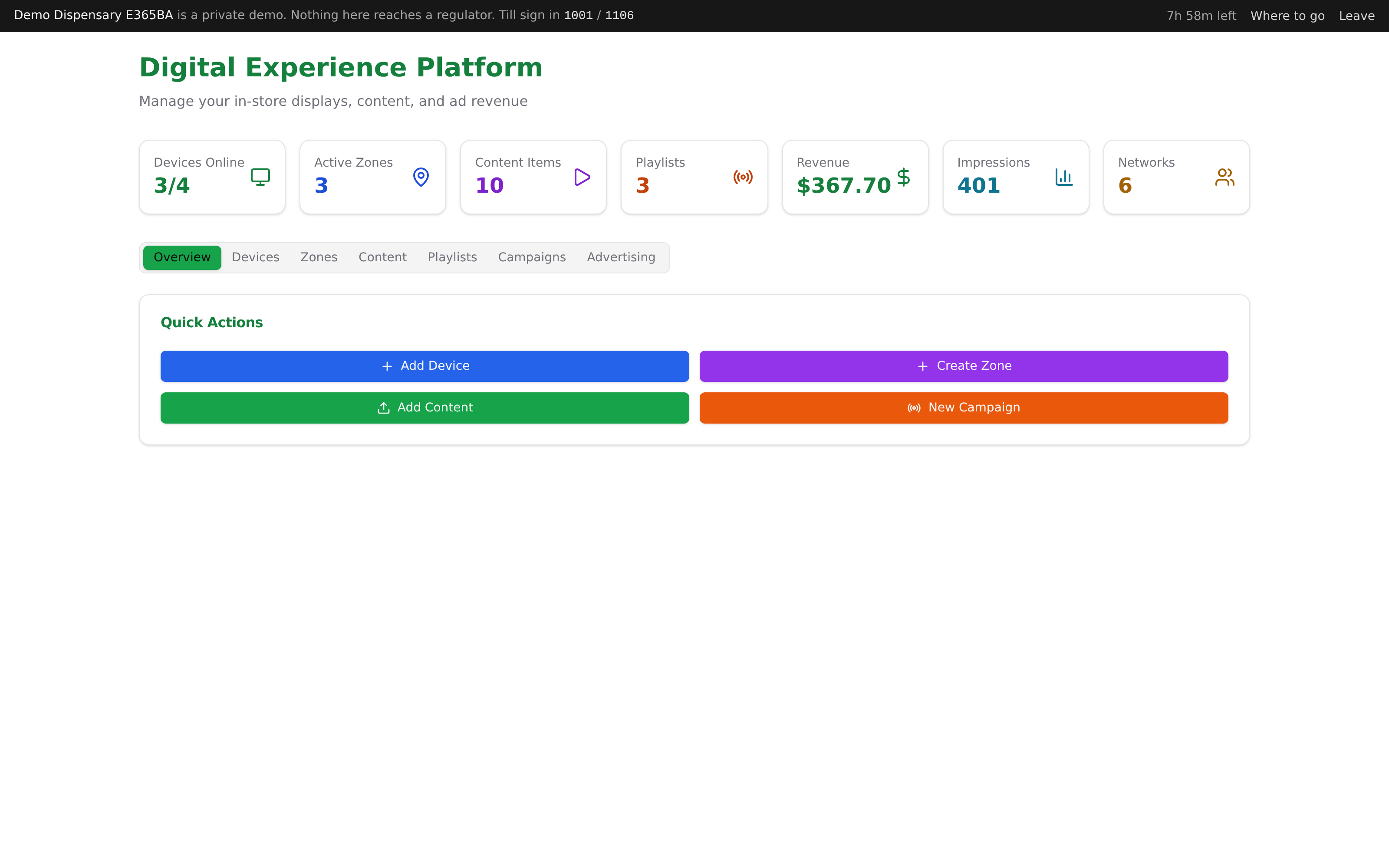
The screens in your shop are yours to program. Menu, deals, house promos, and ad slots you sell to the brands already on your shelf, on your schedule. Most software costs a shop money every month. These can put some back.
The part nobody wants to think about
State reporting, handled.
Every sale files to your state's system in the background. Limits, hours, ID and tax are already set for where you are, so the register does the right thing without anybody configuring it. When something changes in your state, Bloom updates and tells you before it takes effect. When the inspector comes, it is one click.
If you want to know exactly where a number came from, every one of them carries the rule it was priced from and the date we last read that rule, and you can follow it to the state's own text. That is on its own page, with the parts we have not finished listed next to the parts we have.
One thing said plainly rather than in a footnote: Bloom is not yet a validated track and trace integrator in any state. Reporting is built against the published specifications and no sale has been filed to a live regulator yet.
Free, whether or not you buy anything
Your state's rules, kept current for you.
Limits, taxes, hours and what changed this month, for every state we have read. It is free and it stays free, there is nothing to sign up for, and if you never become a customer it still answers the question. Pick yours.
AZ
Arizona transaction privilege tax, retail classification (state rate including the 0.6 percent education increment)
5.6%
A.R.S. 36-2864(A) (marijuana and marijuana products are tangible personal property subject to the transaction privilege tax in the retail classification and use tax); A.R.S. 42-5061 (retail classification); A.R.S. 42-5010(A)(1)(l) (five percent for the retail classification); A.R.S. 42-5010.01(A) (additional rate increment of six-tenths of one percent from and after June 30, 2021 through June 30, 2041)
read 2026-09-06
Open the state's own text
CA
California cannabis excise tax
15%
Rev. and Tax. Code sec. 34011.2(a)(1) (15 percent of gross receipts of any retail sale), (c) (retailer collects and remits), (d) (separately stated on the invoice or receipt), (e) (in addition to sales and use tax), (f) (excise tax is included in gross receipts for sales tax), (g) (no sale unless the tax has been paid); sec. 34015(a); AB 564 (Stats. 2025, ch. 127)
read 2026-09-06
Open the state's own text
CO
Colorado retail marijuana sales tax (15 percent, at the register)
15%
C.R.S. 39-28.8-202(1)(a)(I) (beginning July 1, 2017, a tax at the rate of fifteen percent of the amount of the sale, and a retail marijuana store is not allowed to retain any portion of the tax); C.R.S. 39-28.8-201; 1 CCR 201-18, Rule 39-28.8-201(2) and Rule 39-28.8-202; 1 CCR 212-3, Rule 3-910(A) and (B)
read 2026-09-06
Open the state's own text
IL
Cannabis Purchaser Excise Tax, low potency tier (adjusted delta-9 THC at or below 35 percent)
10%
16.25% with 1 more state charge on the same sale
410 ILCS 705/65-10(a)(1); 410 ILCS 705/65-15(a) (collected from the purchaser and stated as a distinct item separate from the purchase price); 410 ILCS 705/65-25; 410 ILCS 705/65-30; 86 Ill. Adm. Code 423.100(a)
read 2026-10-19
Open the state's own text
MD
Maryland sales and use tax at the cannabis rate
12%
Md. Code, Tax-General Art. 11-104(k)(2) (for fiscal year 2026 and each fiscal year thereafter, 12%), as amended by Ch. 604 of 2025 (HB 352, Budget Reconciliation and Financing Act of 2025); Tax-General 11-104(a); 11-302; 11-401(a); 11-502(a)(1)
read 2026-09-06
Open the state's own text
MA
Massachusetts marijuana excise
10.75%
17% with 1 more state charge on the same sale
M.G.L. c. 64N s.2 (excise at 10.75 per cent of the total sales price, levied in addition to the state sales tax under M.G.L. c. 64H s.2, paid at the time provided for filing the return required by M.G.L. c. 62C s.16); 830 CMR 64N.1.1(3)(a)
read 2026-09-07
Open the state's own text
MI
Marihuana Retailers Excise (MRE) Tax
10%
16% with 1 more state charge on the same sale
MCL 333.27963(1) and (3); Michigan Department of Treasury, Marijuana Retailers Excise (MRE) Tax, Due Dates
read 2026-09-06
Open the state's own text
MO
Missouri adult use marijuana retail tax
6%
Mo. Const. Art. XIV Sec. 2.6(1) (tax at a rate of six percent of the retail price) and Sec. 2.6(4); Missouri DOR Marijuana page
read 2026-10-19
Open the state's own text
NV
Nevada adult-use retail cannabis excise tax
10%
16.85% with 1 more state charge on the same sale
NRS 372A.290(3)(a) and (b); NRS 372A.290(8); NAC 372A.160(1); Department of Taxation Cannabis Establishment Tax FAQs
read 2026-09-06
Open the state's own text
NJ
New Jersey Sales and Use Tax on retail sales of adult-use cannabis
6.63%
N.J.S.A. 54:32B-3(a); NJ Division of Taxation Technical Bulletin TB-104: retail sales of recreational cannabis are subject to Sales Tax; NJ Division of Taxation Sales and Use Tax page: New Jersey assesses a 6.625 percent Sales Tax; N.J.A.C. 17:30-14.3(k) (the cannabis retailer shall collect any tax from a consumer required by the Act and this chapter)
read 2026-09-06
Open the state's own text
NY
New York adult-use cannabis retail excise tax (state share)
9%
Tax Law s.493(b) (an additional tax at the rate of nine percent, imposed on the person who sells adult-use cannabis at retail); Tax Law s.495; 9 NYCRR 123.10(f)(1)(iii) and (f)(2)(v)
read 2026-09-06
Open the state's own text
OR
Oregon state marijuana retail tax
17%
ORS 475C.674(1) and (2)(a) to (g); ORS 475C.682(1) to (4); OAR 150-475-2010; OAR 845-025-2890(1)
read 2026-10-21
Open the state's own text
WA
Cannabis excise tax
37%
43.5% with 1 more state charge on the same sale
RCW 69.50.535(1)(a); RCW 69.50.101(5), (11), (52); WAC 314-55-089; WAC 314-55-090
read 2026-10-20
Open the state's own text
- AZ
- CA
- CO
- IL
- MD
- MA
- MI
- MO
- NV
- NJ
- NY
- OR
- WA
A state appears once its rules have been read line by line against its own statute. Everything published was confirmed against the source it cites, and each fact carries the date that source was read.
Three
None of it counts if it slows the floor down.
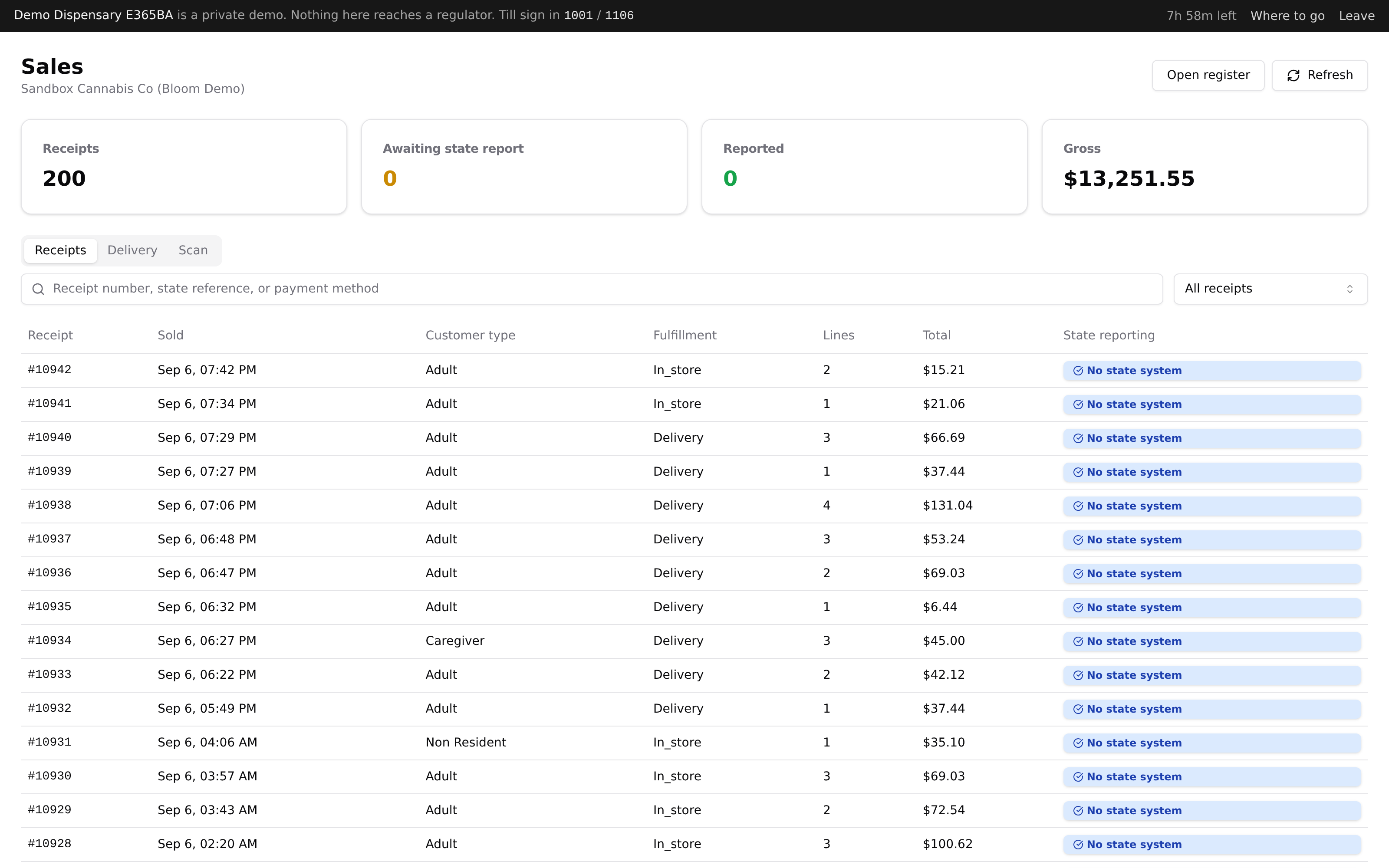
Six screens from the running product, photographed against a live demo shop. Not mockups: the capture refuses to save an image for a page that failed to render.
It has to run the shop, not just the compliance
None of the above matters if the register is slow on a Friday. A budtender learns a sale is refused while the customer is still deciding, not at payment. The cart is priced from the catalogue, checked against the rule pack for that licence, and taxed from published rules. A refusal names the rule that refused it, so the answer to why is on the screen rather than in a support queue.
Purchase limits measured the way the rule measures them, in grams, in milligrams of THC, or as a share of a shared allowance.
A calendar month is a calendar month, not thirty days.
OAR 845-025-2800
Tax computed per line with the statute printed beside it.
ORS 475C.674(1)
A block can only be passed by an override that names the exact rule, with a reason and an approver, written to the evidence log.
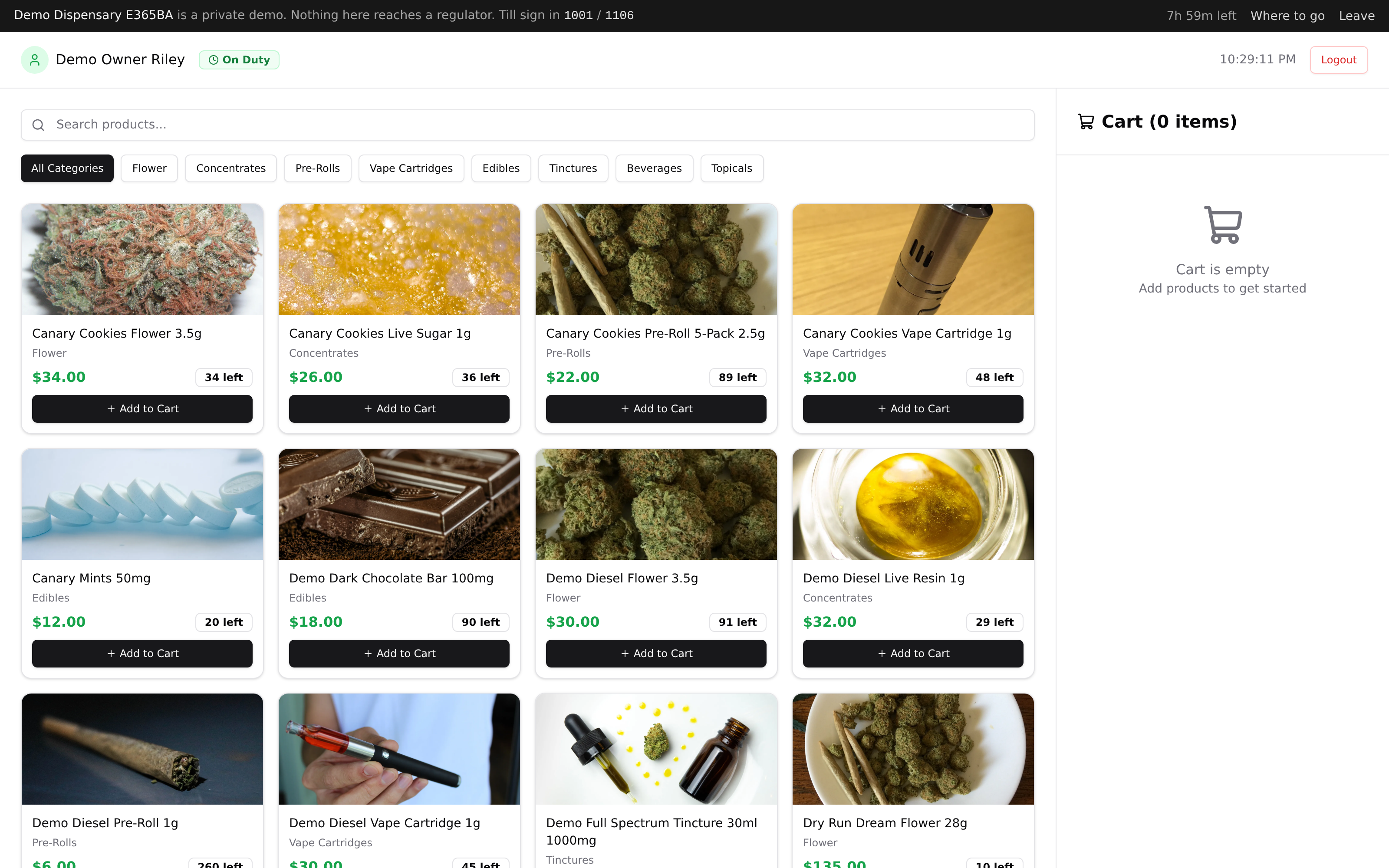
A package knows whether it may be sold
Every package carries its state tag and its lab status, and whether it is sellable is computed by the database rather than set by hand. A package on hold or recalled disappears from the register and from the menu on the wall at the same moment.
State package tags, lab results, and the quantity that is actually left.
Two registers cannot sell the same gram. The second one is refused rather than taking the package negative.
Receiving a transfer, adjusting a package and destroying one all leave a record with the reason code the state expects.
The menu on the wall pays for the software
Screens in a dispensary are the one advertising channel cannabis can legally use at scale. Bloom runs them from the same inventory the register reads: the live menu holds for the interval the owner chooses, flips to a cleared advert for its dwell, and flips back. Every play is logged as evidence, which is what makes an advertiser statement worth anything.
A creative passes ownership, a prohibited claims check, the owner's own zone rules and the jurisdiction's advertising rules before it can play.
A screen visible from the street loses product photography, because a window facing screen is outdoor advertising.
Proof of play is re-checked at report time against the creative on file, so a player cannot bill for a spot that was blocked.
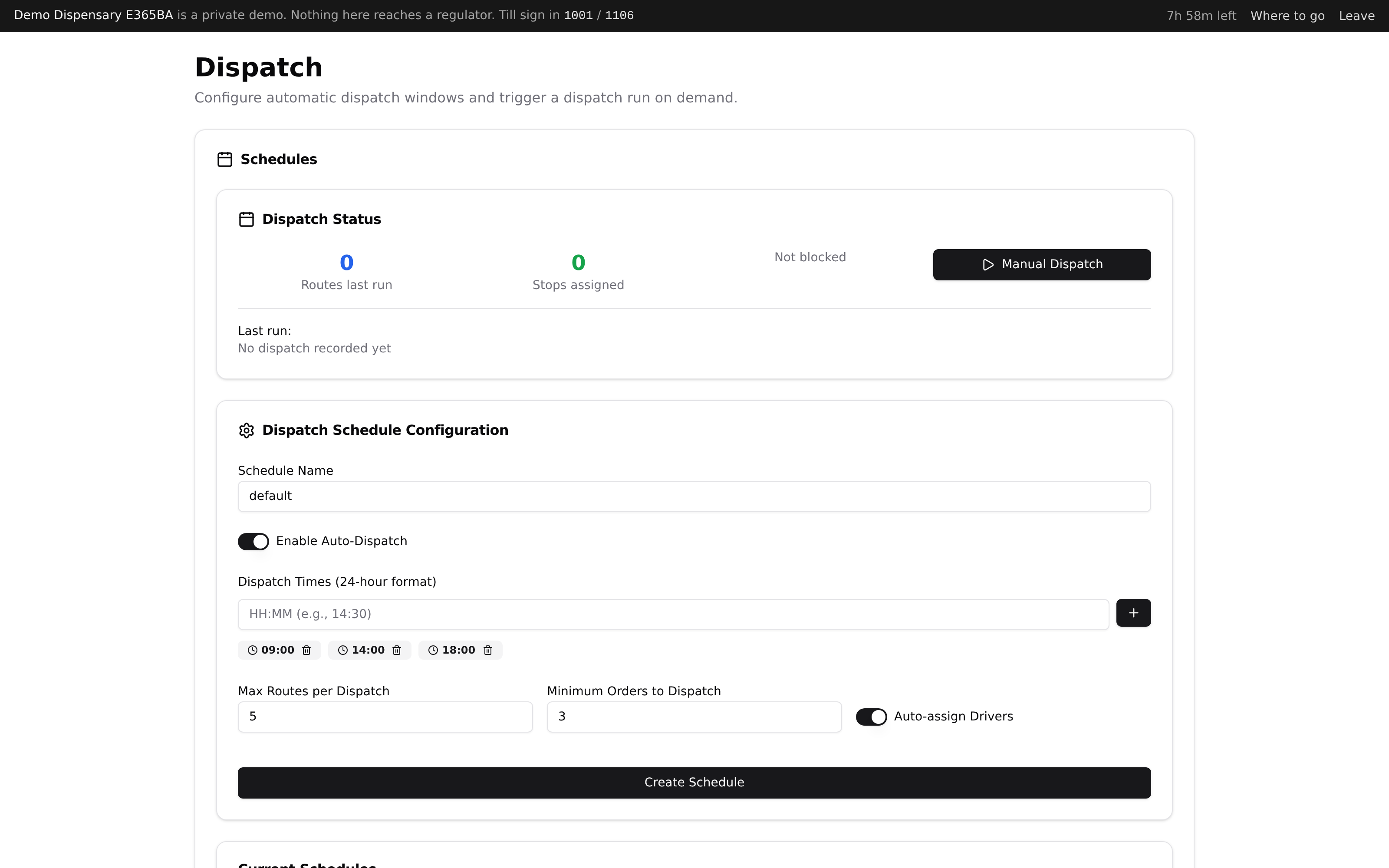
The owner is also the driver
A one person shop opens, sells, packs, drives the route, comes back and closes the till. Bloom plans the route from the shop's own coordinates, carries the manifest, checks identity at the door, and tracks the cash the driver is holding against the ceiling the state allows.
Routes built from the facility's coordinates with a priority weighted tour, not a list in the order the orders arrived.
The door check records the outcome and the age, and in Oregon it records nothing else, because a retailer may not retain what is on the identification.
Where a state requires two people in the vehicle, Bloom says so before the route starts rather than on the road.
What an inspector would be shown
Every decision the engine makes is written down with the version of the rule that made it, so a sale from three months ago can be explained with the rule as it stood that day. The evidence log is append only and the record is the same one the shop sees.
Each decision stores the rule versions that fired and a hash of the context they saw.
A refusal is a record too. An inspector may ask about the sale you did not make.
Reports to the state are queued with an idempotency key, so a retry cannot file the same sale twice.
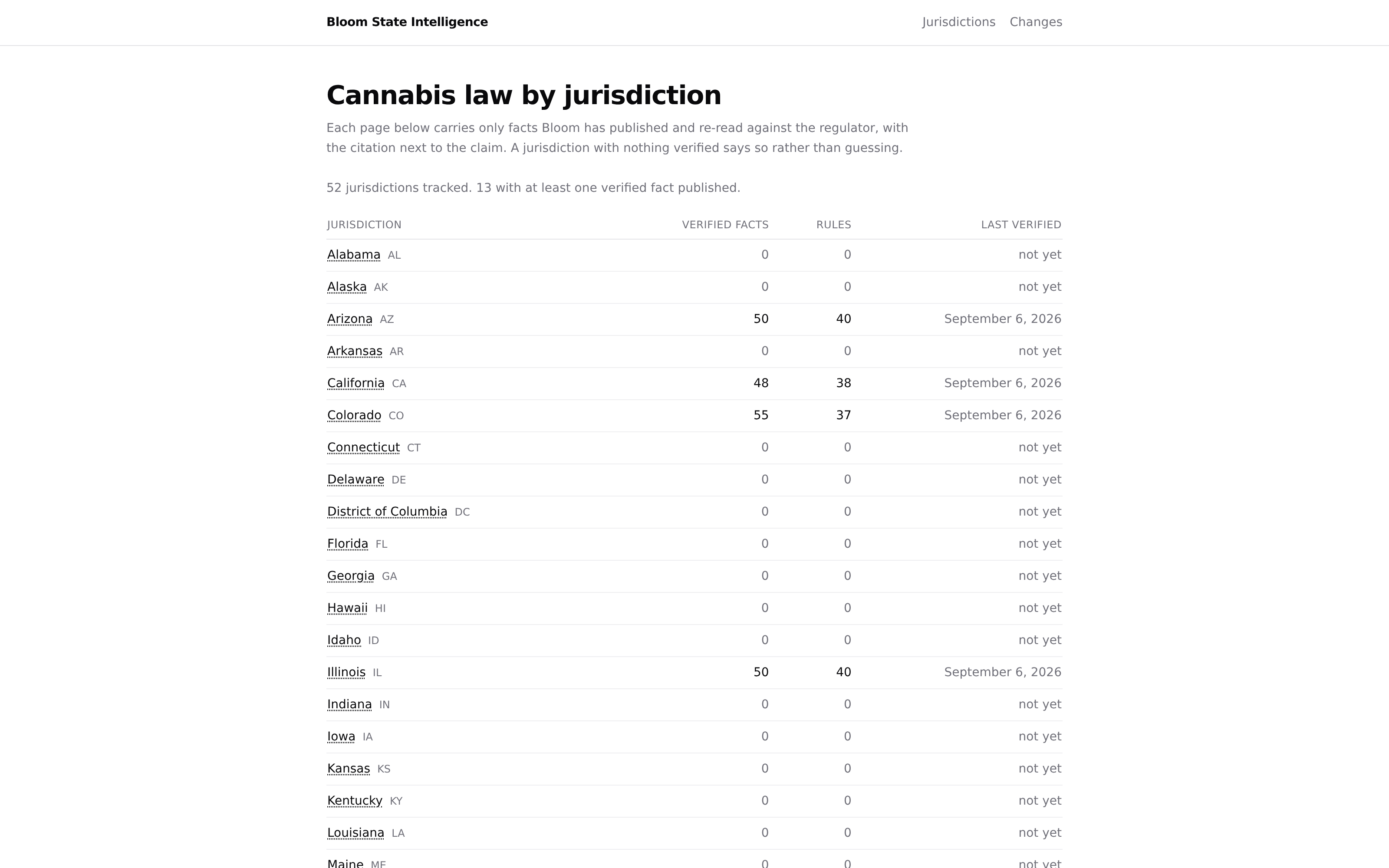
The law, with the date it was last read
The same rows that gate a sale render the public pages. Every fact carries the source it came from, the citation, and when that source was last checked. A fact Bloom has not verified is not shown at all, and the page says so instead of guessing.
Thirteen states read line by line against their own statutes and administrative codes.
Every published fact carries the source it came from and the date it was read.
Fifty two jurisdictions tracked, with coverage stated per state rather than implied.
No lock in
You can leave, and take everything.
Your sales, your packages, your customers, your evidence log and your reports export in full, in formats you can open without us. That is a term of the contract, not a feature we might build.
The state pages stay free and public either way. If you leave, or never start, they still answer your question.
Try it
Walk through a real store.
A grower, a processor and two shops trading with each other. Pick a door and click around. One click, no account, no email, no call, and nothing in it can reach a state system.
The point of all of it is an ordinary day. You open, you sell, you close, and the software was not one of the things you had to think about.
Questions people ask next
- Does Bloom report to my state track and trace system?
- It is built to. A sale writes its report into an outbox with an idempotency key at the moment it is rung, and a worker posts it, so a retry cannot file the same sale twice. Metrc and the Washington CCRS file format are both implemented against their published specifications. Bloom is not yet a validated integrator in any state, and no sale has been posted to a live regulator system.
- Which states has Bloom actually read?
- The state list on this site shows exactly which, and the count changes as the work is done. A state appears only after its rules have been checked against its own statute and administrative code, with the date of that read recorded on each fact. States that have not been read show what is missing rather than a guess.
- What happens when a rule changes after I have already sold something?
- The old row is superseded rather than edited, and both stay. A sale from three months ago is explained with the rule as it stood that day, because the decision recorded which version of which rule made it.
- Can one person run a whole dispensary on it?
- That is the assumption the software is built on rather than a mode it offers. A single owner can open, sell, receive a transfer, drive the delivery and close the till. A second person is required only where a jurisdiction's rule says so, and when that happens Bloom names the rule.
- I already have a point of sale that reports to the state. Why change?
- You may not need to. The question worth asking your current system is which rule it is enforcing and when that rule was last checked. If it can answer, you are covered. If it cannot, the state pages here will tell you what the current rule is, free, whether or not you ever buy anything.
- Do I have to talk to anyone to try it?
- No. The demo opens a private copy of a working dispensary with thirty days of trading history, in one click, with no account and no email. Nothing in it can reach a state system: the database refuses to let a demo licence hold a regulator credential at all.
Sources
- Oregon Administrative Rules, chapter 845 division 25 Oregon Secretary of Stateread 6 September 2026
- Oregon Revised Statutes chapter 475C Oregon Legislatureread 6 September 2026